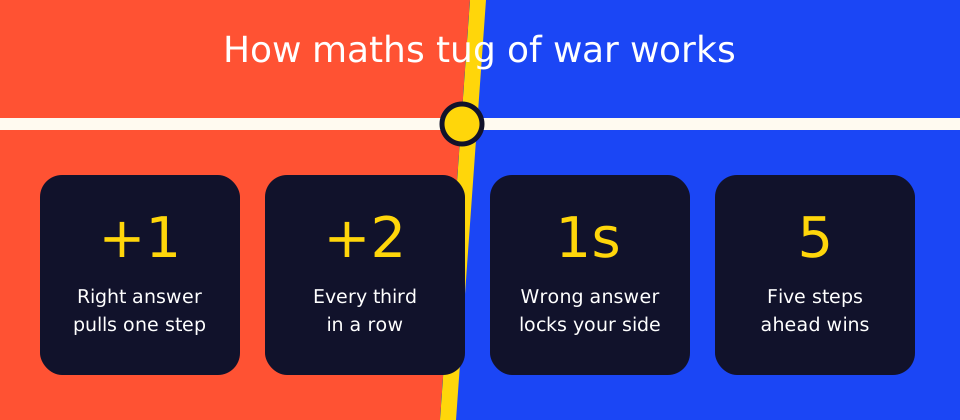
Smartboard tug of war runs a full-screen class match on any touchscreen that accepts two touches at once. Set two team names at the top of this page, pick best of 3, 5 or 7 rounds, and start. Between rounds you see the running score and the most-missed questions.
Time available | Best of | Round length |
|---|---|---|
5 to 8 minutes | 3 rounds | 60 seconds |
10 to 15 minutes | 5 rounds | 90 seconds |
A full activity | 7 rounds | 90 seconds |
Will it work on your board?
The game needs a board that accepts at least two touches at once. Use our board checker before the lesson. If only one touch registers, connect a keyboard so the left team uses Q W E R and the right team uses U I O P, or play in turns.
How do you run it with a class?
Split the class into two teams and write a player order.
Bring one player per team to the board, standing at their own side.
Everyone else works out each question on a whiteboard and stays quiet until the swap.
Change players after each round so more students get a turn.
Between rounds, take the top question on the missed list and ask for a method.
Keeping it inclusive
Speed games can be hard on people who need more time. Use a longer match and let pairs answer together. Give the two teams their own levels if one needs easier numbers, and see the mixed-ability guide for grouping ideas.
Other ways to play as a class
If every student has a device, an online room keeps everyone answering. For several teams on one board, use the tournament tool. Students do not sign in, and you should use team names rather than students' real names.
How many students get a turn?
| Match | Most rounds | One player per side | Pairs per side |
|---|---|---|---|
| Best of 3 | 3 | 6 students | 12 students |
| Best of 5 | 5 | 10 students | 20 students |
| Best of 7 | 7 | 14 students | 28 students |
If you want a class of about 30 at the board in one sitting, use best of 7 with pairs. A pair can share the job, with one student reading and one tapping.
What should the rest of the class do?
- Answer each question on a mini whiteboard and hold it up at the swap.
- Keep a tally for their team of questions they got right.
- Act as the next pair and rehearse the routine for swapping sides.
- Choose the question from the missed list to discuss next.
Setting up the two teams
Choose teams in advance and mix confidence inside each one. Give both teams the same level for a true contest, or different levels if one team needs smaller numbers. Pick a topic the class has already been taught, because the game is for practice. Agree a signal for the swap, and stand to one side of the board so you do not block anyone's view.
What to do between rounds
Take one question from the most-missed list and ask two students for different methods. Thirty seconds of this after each round gives the match its teaching value, and it gives the next pair time to come forward.
Frequently asked questions
How does the class match work?
Choose two team names and best of 3, 5 or 7 rounds. The page keeps the running score and lists the most-missed questions.
What if the board only accepts one touch?
Connect a keyboard so each team can use its own keys.
Do students need to log in?
No. Students do not sign in.