Tug of War and Forces: Free Body Diagrams Explained
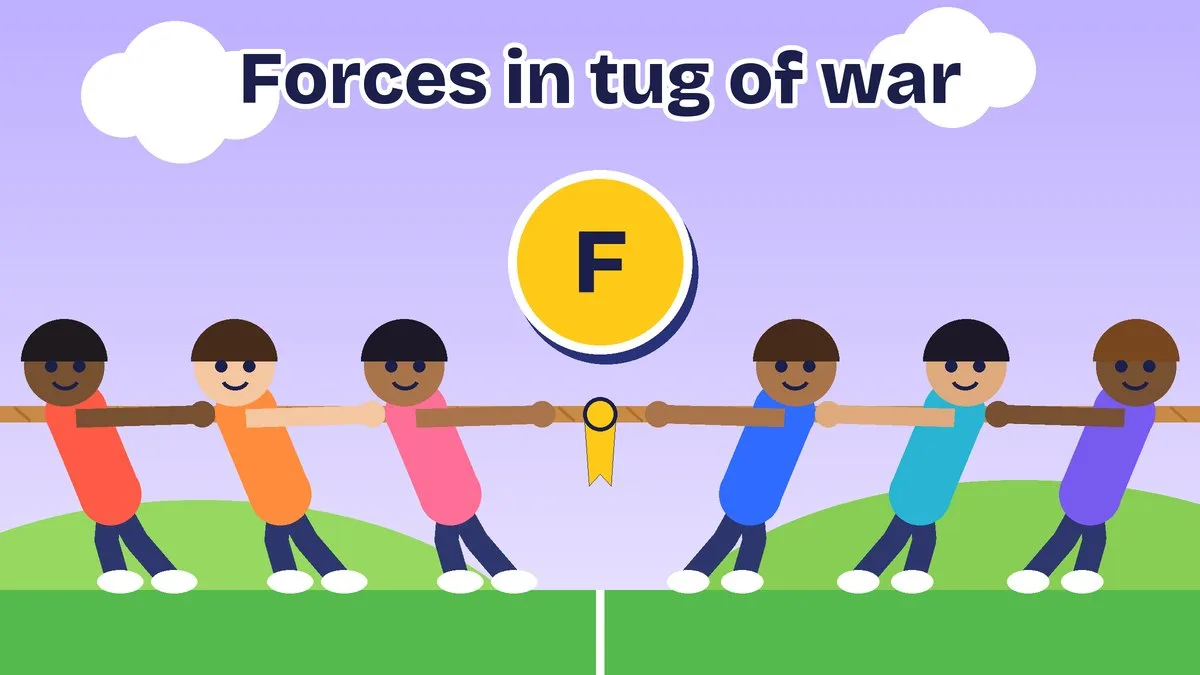
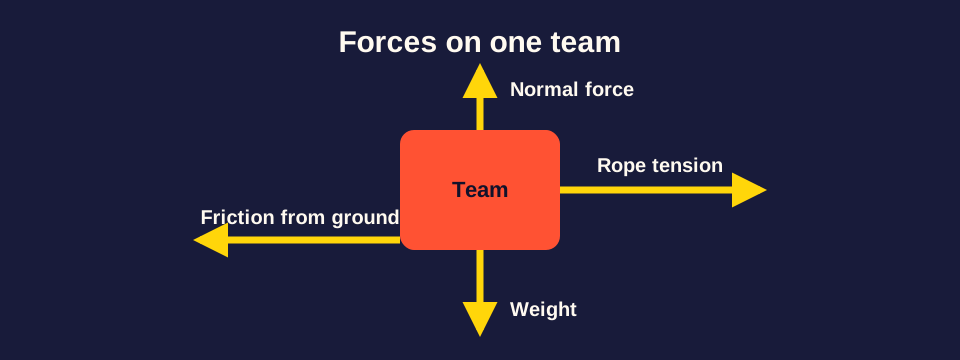
The mechanics of tug of war are simple: the team that pushes harder against the ground wins, not the team that pulls harder on the rope. A tug of war free body diagram for one team, drawn as a box, has these four forces.
Force | Direction | Comes from |
|---|---|---|
Weight | Down | Earth's gravity |
Normal force | Up | The ground |
Rope tension | Toward the middle | The rope |
Friction | Away from the middle | The ground |
The two vertical arrows balance. The two horizontal arrows decide what happens: if friction is greater than tension, that team accelerates away from the middle.
Forces on the rope
By Newton's third law, each team and its end of the rope pull on each other with equal force. Treat the rope as light and taut. Its tension is the same along its length, so both teams feel the same pull. The tension equals one team's pull. It is not the sum of both pulls.
Who wins?
Newton's second law says net force equals mass times acceleration. Consider the whole system of both teams and the rope. The rope forces are internal and cancel. Only the friction forces from the ground accelerate the system, so the team able to develop the greater friction force moves the system its way.
A tug of war math problem, worked
Team A can get up to 1,500 N of friction and Team B up to 1,200 N. The two teams and rope have a total mass of 600 kg. If both are at their limit, net force is 300 N toward A, so acceleration is 300 ÷ 600 = 0.5 m/s².
To find the tension, look at Team B alone, with a mass of 280 kg. B moves toward A at 0.5 m/s². The net force on B is T − 1,200 = 280 × 0.5 = 140, so the tension is 1,340 N. Check with Team A, mass 320 kg: 1,500 − T = 320 × 0.5 = 160, which also gives 1,340 N.
Why technique matters
Leaning back lowers the centre of mass, and bracing the feet helps turn leg strength into ground force. Heavier teams can usually produce a larger maximum friction force, as friction depends on the normal force, and good footwear increases grip. Friction limit is the friction coefficient times the normal force, so a 100 kg team member on a surface with a coefficient of 0.6 can get about 100 × 9.8 × 0.6 = 588 N.
Common mistakes
Students often say tension is double one team's pull, or say the stronger pull wins, forgetting that the pulls on the rope are equal in magnitude if the rope is light. Another error is drawing friction in the direction of motion for the wrong team. Check each arrow by asking what object pushes on what.
The maths version
In maths tug of war none of this applies, because only correct answers move the rope. Play a match to try it.
What happens when the teams are evenly matched?
If each team can develop more friction than the rope tension and neither moves, the system is in equilibrium. Net force is zero, the rope tension equals each team's friction force, and nothing accelerates. The rope tension can still be large. Two teams each holding with 1,000 N have 1,000 N of tension, not 2,000 N.
A second problem to try
Team A has a total mass of 450 kg and Team B has 400 kg. The rope is light. Team A can develop at most 2,000 N of friction and Team B 1,700 N. What is the acceleration, and what is the tension?
Net force on the system is 2,000 − 1,700 = 300 N toward A. Total mass is 850 kg, so acceleration is 300 ÷ 850 = 0.35 m/s², to two decimal places. For Team B moving toward A, T − 1,700 = 400 × 0.35 = 140, so tension is about 1,840 N. Check with Team A: 2,000 − T = 450 × 0.35 = 158, which gives about 1,842 N, the same answer allowing for rounding.
Frequently asked questions
What decides who wins a tug of war in physics?
The team able to develop the greater friction force against the ground moves the system its way.
Is rope tension the sum of both teams' pulls?
No. For a light rope that is not accelerating, tension equals one team's pull.
Do heavier teams have an advantage?
They can usually produce a larger maximum friction force, because friction depends on the normal force.