To run a math tug of war competition in class, plan for about 20 minutes, four short matches and a job for every pupil who is not at the board. Enter your teams in the tool at the top of this page, then follow this plan.
Minutes | What happens |
|---|---|
0 to 3 | Explain the rules and give each team member a role |
3 to 15 | Four 60 to 90-second matches, with a one-minute team huddle after each |
15 to 20 | Review the hardest facts, and each pupil writes one strategy |
Before the lesson
Choose facts the class has already been taught.
Test the board with two people tapping at once. If only one touch registers, connect a keyboard.
Set the operation, tables and match length in the settings.
Decide teams in advance, and enter them as a knockout for 2 to 16 teams or a league for up to 8.
How should you form teams?
Mixed teams of four to six work well, with a range of confidence in each. Research on cooperative formats points to structure inside the team as the thing that matters, so give each member a job: player, checker, strategy lead or coach. Rotate these roles every round, and never let pupils pick teams publicly.
How do you keep everyone working?
While two pupils play, the rest answer on mini whiteboards, working out the same kind of question. Teams earn a bonus point for a question their member missed but the team solved afterwards. This turns watching into practice and takes pressure off the pupil at the front. If every pupil has a device, an online room lets the whole class answer at once.
Fair play
Give each team a level that lets it answer accurately, and say out loud that a level is a setting and not a judgement. Praise useful strategies and improvement more than winning. Our mixed-ability guide has more.
End with teaching
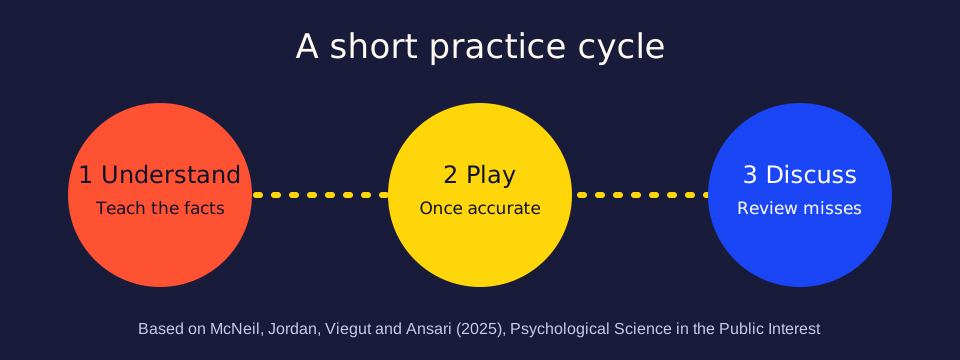
Bring up the review list at the end of each match. Choose the fact most teams missed, and ask two pupils to explain different ways to work it out. A 2025 review in Psychological Science in the Public Interest recommends moving from practice back to discussion, and this is where that happens. Four rounds is usually enough, because attention fades and the review matters more than a fifth match. For other formats, see tournament brackets.
What does each team member do?
| Role | Job during the round |
|---|---|
| Player | Answers at the board |
| Checker | Works out each question on a whiteboard |
| Strategy lead | Runs the one-minute huddle and picks a method to try |
| Coach | Notes one thing the player did well |
A simple scoring system
Award 3 points for a match win and 1 for a draw. Add 1 bonus point for each missed question a team solves afterwards, up to a limit of 2 per round. The bonus keeps teams working after a loss, and it means the team with the best review can overtake the team with the fastest player.
What can go wrong, and what do you do?
| Problem | Fix |
|---|---|
| One team wins every match | Raise its level, or swap a player between teams |
| Noise during matches | Agree that only the checker may show an answer, and only after the round |
| A student refuses to play | Offer the checker or coach role instead |
| You run out of time | Drop a round and keep the review |

Frequently asked questions
How long does a classroom tug of war competition take?
The plan on this page takes about 20 minutes, with four matches of 60 to 90 seconds and time for review.
How many teams can the tournament tool handle?
The tool at the top of this page takes 2 to 16 teams in a knockout, or up to 8 teams in a league.
What happens if a tournament match is tied?
In a knockout, a level match with equal scores must be replayed. In a league, it counts as a draw.