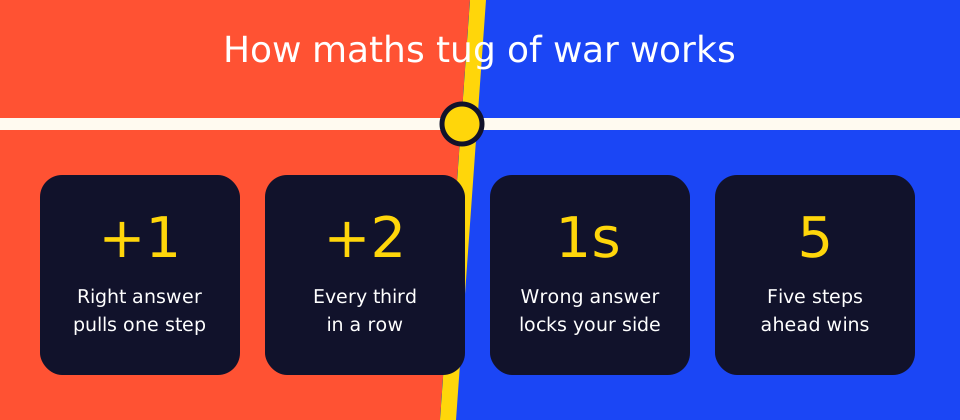
Division tug of war is a free two-team game: divide to pull the rope, and a five-step lead wins. Every answer is a whole number. For the best practice, tick the tables you already know in the settings and use these starting points.
Goal | Settings | Example |
|---|---|---|
First division facts | Tick 2, 5 and 10, Easy (up to 10) | 40 ÷ 5 |
One table at a time | Tick one table, Medium (up to 12) | 84 ÷ 7 |
Full tables revision | Nothing ticked, Medium | Up to 144 ÷ 12 |
A stretch | Nothing ticked, Hard (up to 20) | Up to 400 ÷ 20 |
When you tick a table, it is always the number you divide by, and the answer runs from 1 up to your level. Each team can have its own level on one screen.
How is division linked to multiplication?
Knowing 7 × 8 = 56 also gives 56 ÷ 7 = 8 and 56 ÷ 8 = 7. Ask "7 times what makes 56?" Someone who treats each division fact as new has far more to remember than someone who sees the family of facts. Build the times tables first, then play the same table here so the two connect.
Quick methods for harder divisions
Dividing by | Method | Example |
|---|---|---|
2, 4 or 8 | Halve once, twice or three times | 72 ÷ 8: 36, 18, 9 |
5 | Double the number, then divide by 10 | 45 ÷ 5: 90, then 9 |
6 | Halve, then divide by 3 | 54 ÷ 6: 27, then 9 |
12 | Halve, halve, then divide by 3 | 108 ÷ 12: 54, 27, 9 |
What mistakes are most common?
Reversing the numbers is common: reading 42 ÷ 6 as 6 ÷ 42. Players may also confuse a fact with a near neighbour, answering 54 ÷ 6 as 8 when it is 9. The three wrong buttons are always close to the right answer, so a near guess is rarely enough. If someone repeats these on the review list, return to multiplication and arrays before more speed practice.
When to wait
If a player is not yet accurate with a division fact, teach it first. The 2025 review led by Nicole McNeil recommends timing only after accuracy, and a game is no substitute for understanding what sharing and grouping mean.
Standards covered
In the United States, Common Core 3.OA.C.7 expects fluent multiplication and division within 100. In England, pupils should recall related division facts up to 12 × 12 by the end of Year 4. See also ideas for grades 4 and 5.
A round of division, played through
Red has ticked the 6s and 7s at Medium. The first question is 42 ÷ 6. Red thinks "6 times what makes 42?" and answers 7. Next is 84 ÷ 7, which is 12. Then 54 ÷ 6: halve to get 27, divide by 3, answer 9. That is three correct in a row, so the last answer is a power pull. Red spent no time on the wrong buttons, because each of them was close enough to be tempting.
Which divisions usually need the most work?
The facts that are hard to multiply tend to be hard to divide, and division adds an extra step. Pay special attention to the families around 6 × 7, 6 × 8, 7 × 8 and 8 × 9. Work on each family as a set of four: 7 × 8, 8 × 7, 56 ÷ 7 and 56 ÷ 8.
Using division with multiplication
Play a multiplication match and a division match on the same tables, one after the other. Compare the two review lists. A fact that is missed only in division shows the player knows the product but has not linked it the other way, which is quick to fix by saying the whole fact family aloud.
Frequently asked questions
Are division answers always whole numbers?
Yes. Every division question in this game has a whole-number answer.
Can I choose which tables are used?
Yes. Tick the exact tables in the settings.
Can each team have its own level?
Yes. On one screen, each team can have its own level.