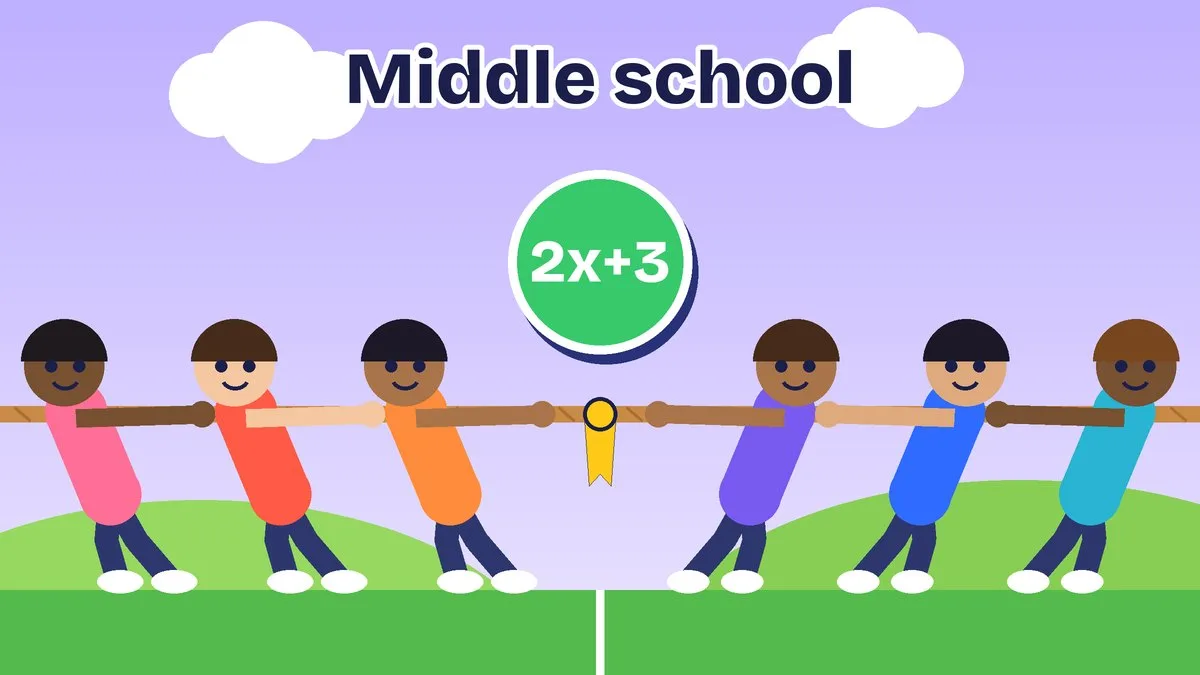
For math tug of war in middle school, use the game at the top of this page as a quick warm-up. It mixes negative numbers, fractions, percentages, order of operations, simple algebra, and squares and roots, so older students are not stuck on basic number facts. Use these settings.
Goal | Settings | Example |
|---|---|---|
Mixed starter | Middle school set, Hard, 90 seconds | 3x + 4 = 19 |
Integers | Negative numbers, Easy or Medium | −7 − (−3) |
Percentages | Percentages, Hard | 20% of 45 |
Order of operations | Order of operations, Medium | 7 + 3 × 4 |
Strongest students | Middle school set, Master | 85% of 60 |
The middle school set never goes below Medium difficulty, and two-step equations appear from Hard upward.
The wrong answers test real misconceptions
In order of operations questions, one wrong button is the answer you get by working left to right, so 7 + 3 × 4 tempts you with 40 when the answer is 19. In negatives, one wrong button comes from confusing adding and subtracting. Fraction addition offers the classic mistake of adding tops and bottoms. These are the errors worth discussing after a match.
Why keep it short?
Older students do not need long sessions of recall. Use one match as a starter, then discuss the questions the class missed. Include errors such as treating (−3) squared as −9.
Team structure
Rotate players, and let the rest of the class answer on paper to win a bonus point for their team. Avoid putting a struggling student alone in front of the class. If everyone has a device, an online room keeps every student answering at once.
Writing your own set
The custom questions page suits the exact skills your class is working on now. Try −7 + 3 = −4, 12 squared = 144, 25% of 80 = 20, 3 + 4 x 2 = 11, and If x + 9 = 15, x = 6.
What the game cannot do
The game cannot assess reasoning or show method. Use it for quick recall, and keep problem solving for richer tasks. See negative numbers and fractions for topic detail.
What do percentages and powers look like at each level?
| Level | Percentages used | Squares and roots up to |
|---|---|---|
| Medium | 10%, 25%, 50% | 12 squared |
| Hard | 5%, 10%, 20%, 25%, 75% | 15 squared |
| Expert | 5%, 15%, 30%, 40%, 60%, 75% | 20 squared |
| Master | 15%, 35%, 45%, 65%, 85% | 25 squared |
Quick methods worth teaching
- Percentages: find 10%, then build. 35% of 60 is 18 + 3 = 21.
- Two-step equations: undo in reverse order. For 3x + 4 = 19, subtract 4 to get 15, then divide by 3 to get 5.
- Order of operations: scan for brackets and multiplication before you start adding.
- Roots: learn squares to 15 in both directions, so √169 is as quick as 13 squared.
Making it feel right for older students
Frame the match as a warm-up rather than a game for its own sake. Let students choose the topic for the day, or have the previous winners set a custom question set for the class. Team-based play and short rounds usually sit better with this age than individual contests at the board.
Frequently asked questions
Which topics are in the middle school set?
The set mixes negative numbers, fractions, percentages, order of operations, simple algebra, and squares and square roots.
Is the game too young for older students?
It depends on the content. Use the Hard level or above, and treat a match as a short warm-up.
Can the game check reasoning?
No. It practises quick recall, so keep problem solving for richer tasks.