For math tug of war in grades 2 and 3, use the settings below. Children at this stage are moving from working facts out to remembering them, and short matches fit that well. The game at the top of this page already mixes the right topics, so you can press Play or narrow it down.
Grade | Topic | Level | Match |
|---|---|---|---|
Grade 2, start of year | Addition, or subtraction | Easy (up to 10) | 90 seconds |
Grade 2, end of year | Addition, or subtraction | Hard for subtraction (up to 20), Easy for addition | 90 seconds |
Grade 3, early | Multiplication, tick 2, 5 and 10 | Medium (up to 12) | 90 seconds |
Grade 3, later | Multiplication, add 3, 4 and 8 | Medium | 90 seconds, then 60 |
This page's mix asks addition, subtraction, number bonds, doubles and halves, missing numbers and early multiplication, and stops at Medium difficulty.
What are children expected to know?
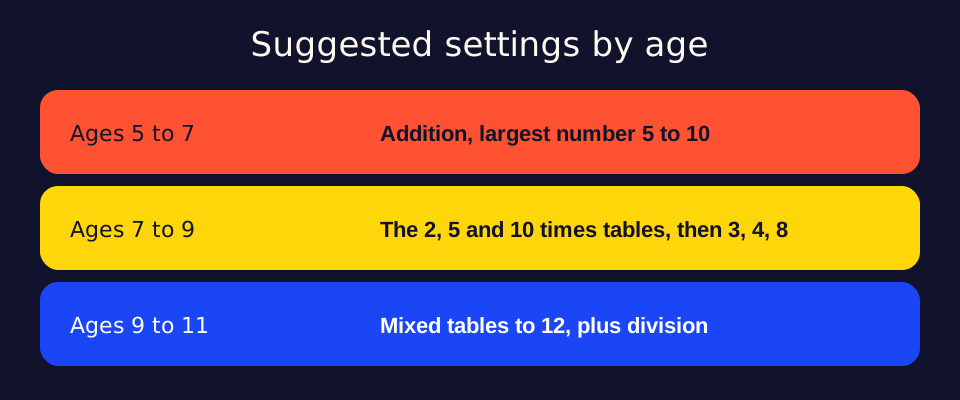
Common Core asks second graders to fluently add and subtract within 20 using mental strategies, and third graders to fluently multiply and divide within 100 by the end of the year. In England, pupils learn the 2, 5 and 10 times tables in Year 2 and the 3, 4 and 8 times tables in Year 3.
A ten-minute lesson
Minutes | Activity |
|---|---|
0 to 3 | Teach one strategy, such as doubles or making ten |
3 to 5 | Partners practise five questions with no clock |
5 to 7 | Play one match while the class answers on whiteboards |
7 to 10 | Pick one missed fact and ask two children to explain it |
This order follows the 2025 review by McNeil and colleagues, which recommends understanding first, brief timed practice next and discussion afterwards.
Supporting mixed classes
Give each team its own level, pair children who need more time, and let a child who dislikes performing act as coach and check answers. The mixed-ability guide goes further.
How do you check progress without a score?
Keep the review lists for a week. If the same fact keeps appearing, teach it again. If the lists shrink, add harder facts, or move on to more times tables.
What does this page's mix ask?
| Question type | Example | What to teach first |
|---|---|---|
| Number bonds | 7 + ? = 10 | Pairs that make 10 |
| Doubles and halves | Double 8, half of 18 | Doubles up to 10 |
| Missing numbers | ? + 5 = 9 | Using the inverse |
| Early multiplication | 4 × 6 | Skip counting and arrays |
Which strategies should you teach by grade?
In grade 2, focus on making ten, near doubles and using addition to solve subtraction. In grade 3, focus on skip counting, doubling the 2s to get the 4s and the 4s to get the 8s, and the link between multiplication and division. Each strategy gets one short teaching moment before a match, and players try it during play.
What should you say after a match?
Try "Which question made you stop and think?" and "Show me another way to do that one." Avoid naming who won in the discussion. Two children explaining different routes to the same answer is the most useful thing that can happen in those three minutes.
Frequently asked questions
Which topics are in the grades 2 and 3 set?
The set mixes addition, subtraction, number bonds, doubles and halves, missing numbers and early multiplication.
Can a class practise only certain times tables?
Yes. Choose multiplication in the settings, then tick the tables you have taught.
What do the review lists show?
After each match, the review list shows the questions each team got wrong, with the correct answers.