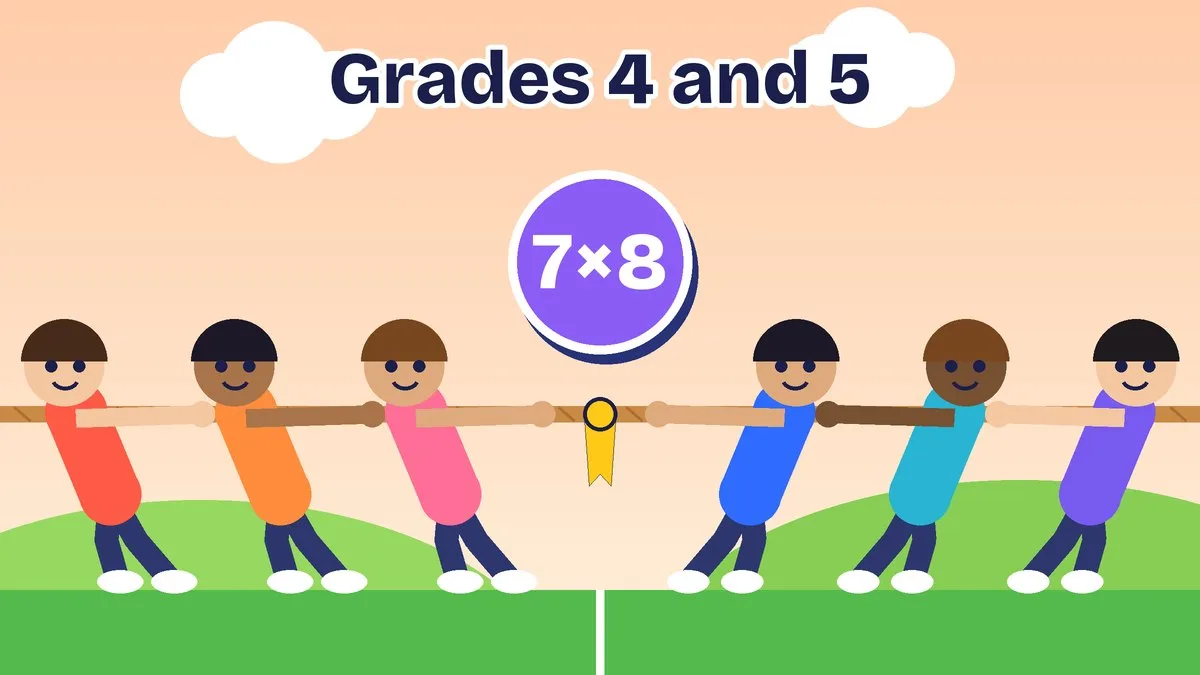
For math tug of war in grades 4 and 5, focus on the harder times tables and the division facts that go with them, so pupils can spend their attention on bigger calculations. Use these settings in the game at the top of this page.
Goal | Topic and settings | Example |
|---|---|---|
Harder tables | Multiplication, tick 6, 7, 8, 9 and 12, Medium | 8 × 7 |
Inverse facts | Division, same tables, Medium | 56 ÷ 7 |
A mixed warm-up | Grades 4 and 5 set, Medium or Hard | 3/4 of 20, 0.7 + 0.5 |
Fractions | Fractions topic, 2 or 3 minutes | Simplify 12/18 |
The grades 4 and 5 set mixes multiplication, division, missing numbers, fractions of amounts, comparing fractions and decimals. It is already selected above.
Why keep practising facts at this age?
Long multiplication, fractions and division with remainders all lean on quick recall. A pupil who has to work out 7 × 8 in the middle of a long calculation loses the thread. Many pupils know 7 × 8 but hesitate on 56 ÷ 7, so include division matches.
Extend with custom questions
The custom questions page lets you write your own sets with numeric answers. Useful ones at this level include powers of ten (34 × 10 = 340), halves of even numbers (half of 76 = 38), and factor questions (27 ÷ 3 = 9).
How do you keep everyone involved?
At this age, whole-class watching quickly loses attention. Run a team format with mini whiteboards, put pupils on tablets in pairs, or use an online room so everyone answers at once. Our guide to running a classroom competition has a full plan.
Mixed-level teams
On one screen, give each team its own level. A pupil who still needs the 2s and 5s can play alongside one working on 12s, and a correct answer counts the same.
Use the results
After a match, ask pupils to pick one fact from the review list and write how they can work it out. For 8 × 7, a pupil might use 8 × 5 plus 8 × 2. Being able to rebuild a fact is more useful than memorising it alone, and the 2025 review led by McNeil supports pairing fluency with reasoning.
What does this set ask at each level?
| Level | Decimals | Fractions of amounts |
|---|---|---|
| Starter | One decimal place, such as 0.4 + 0.3 | Halves only |
| Easy | One decimal place, up to 5 | Halves and quarters |
| Medium | Two decimal places, up to 10 | Non-unit fractions, such as 2/3 of 12 |
| Hard | Two decimal places, up to 20 | Up to eighths |
A four-week warm-up plan
| Week | Focus | Discuss afterwards |
|---|---|---|
| 1 | 6s and 7s, then matching division | Fact families such as 42, 6 and 7 |
| 2 | 8s and 9s, then matching division | Doubling three times, and the 10s minus one lot |
| 3 | Fractions of amounts | Why you divide before you multiply |
| 4 | Grades 4 and 5 mixed set | Which question type needs more work |
Which common errors should you listen for?
With decimals, pupils often treat 0.7 + 0.5 as 0.12 by adding the digits as whole numbers. With comparing fractions, they may think 1/8 is bigger than 1/4 because 8 is bigger. With division, they may give the answer to a nearby fact. Each of these shows up on the review list, so pick the pattern you see most and address it in the next lesson.
Frequently asked questions
Which topics are in the grades 4 and 5 set?
The set mixes multiplication, division, missing numbers, fractions of amounts, comparing fractions and decimals.
Which times tables need the most practice at this age?
The harder tables are usually the 6s, 7s, 8s, 9s and 12s, so select those in the settings.
Can pupils write their own questions?
Yes. The custom questions page accepts one question per line with a number answer.