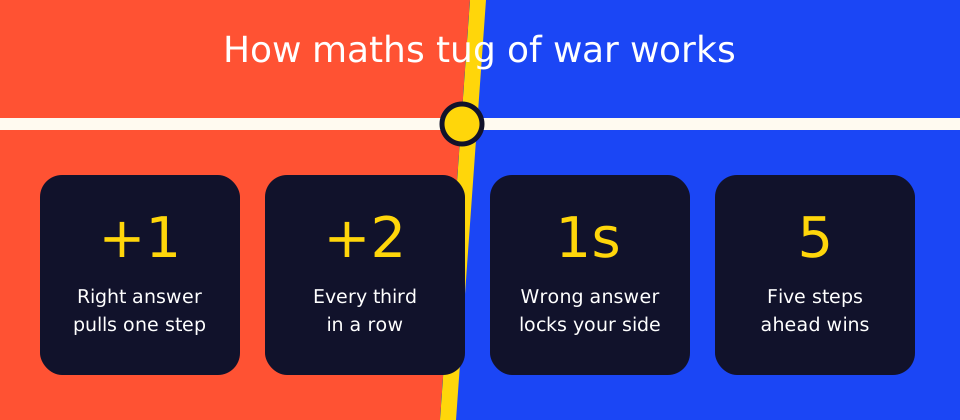
Addition tug of war is a free game for two teams: answer addition questions to pull the rope to your side, and a five-step lead wins. Pick the level below that matches the players, and give each team its own level if abilities differ.
Level | Example | Largest sum | Suits |
|---|---|---|---|
Starter (up to 5) | 3 + 4 | 10 | Absolute beginners |
Easy (up to 10) | 8 + 7 | 20 | Learning facts to 20 |
Medium (up to 12) | 11 + 9 | 24 | Secure on facts to 20 |
Hard (up to 20) | 17 + 16 | 40 | Fluent adders |
Expert (up to 50) | 38 + 47 | 100 | Mental arithmetic |
Master (up to 100) | 86 + 79 | 200 | A real workout for adults |
Both numbers in a question come from 1 up to the level. If you want quick recall, pick a level where most answers come fast. Above Easy, most players are calculating, so use a 2 or 3-minute match.
Mental strategies worth naming
Strategy | Example |
|---|---|
Start with the larger number | 2 + 9: start at 9, say 10, 11 |
Near doubles | 6 + 7 is 6 + 6 + 1 = 13 |
Make ten | 8 + 5 is 8 + 2 + 3 = 13 |
Tens, then units | 38 + 47 is 78 + 7 = 85 |
Round and correct | 46 + 39 is 46 + 40 − 1 = 85 |
What mistakes are most common?
Beginners who count on often say the starting number as their first count. For 7 + 3 they say "7, 8, 9" and answer 9, so answers one too small point to this habit. In two-digit sums, the usual error is forgetting to carry, which gives 75 for 38 + 47. The game's wrong buttons include answers exactly 10 away, so careless carrying gets caught. Use the review list to see which pattern a player has.
Make it a fair match
Give each team a level where it answers at about the same speed. Small gaps decide matches quickly, as the simulation in our guide to the rules shows. When sums feel easy, move to subtraction, which uses the same facts in reverse. For the youngest learners, see the kindergarten and grade 1 guide.
Standards covered
In the United States, this supports Common Core 2.OA.B.2. In England, it supports the Year 2 expectation to recall addition and subtraction facts to 20.
A round of addition, played through
Red is on Easy and Blue on Medium. Red sees 7 + 8 and thinks "double 7 and one more", so 15. Blue sees 11 + 9, makes 20 by moving one across, and taps. Both pull, so the rope stays level. Red's next two answers come quickly: 4 + 6 and 9 + 5. That third correct answer in a row is a power pull of two, and Red is ahead. Notice that the score came from having a method for each sum, not from counting on.
How do you know when to move up a level?
Play three matches at one level and look at the review lists. Move up when a player has at most one or two questions on each list and answers without counting on fingers. Stay put if the same sums keep appearing, and pick one of the strategies above for them. Move down if the player starts guessing.
A two-week addition plan
| Days | Focus | Level |
|---|---|---|
| 1 and 2 | Number bonds to 10 | Number bonds topic, Easy |
| 3 and 4 | Doubles and near doubles | Doubles and halves topic, Easy |
| 5 and 6 | Making ten across the tens | Addition, Easy |
| 7 and 8 | Mixed facts to 20 | Addition, Easy, shorter matches |
| 9 and 10 | Tens and units | Addition, Hard, 3 minutes |
Each day needs only one or two matches and a minute with the review list.
Frequently asked questions
What age is addition tug of war for?
Any age. Levels run from Starter (up to 5) to Master (up to 100).
Can it be played on a phone?
Yes, though two people on one screen will find a tablet or larger screen more comfortable.
Can two people play at different levels?
Yes. Each team can have its own level in the settings.