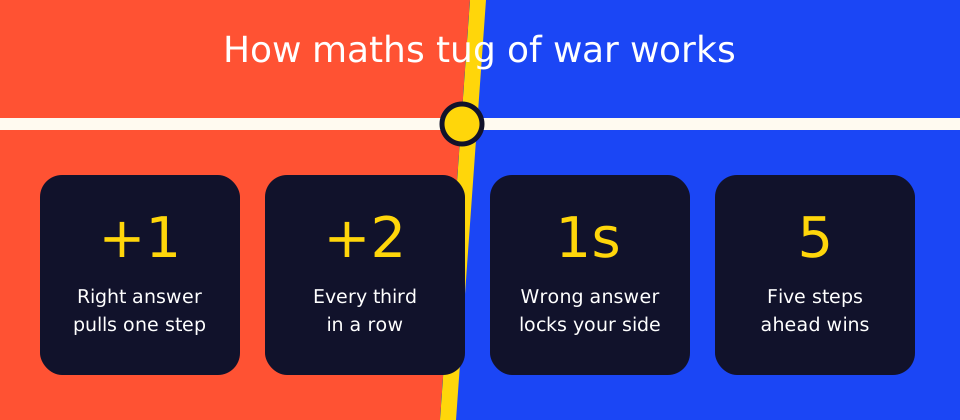
Multiplication tug of war is a free two-team game: each correct multiplication answer pulls the rope toward your side, and a five-step lead wins. Use these settings in the game above, and give each team its own level if abilities differ.
Your goal | Settings | Different facts |
|---|---|---|
Learn one table | Tick it, Medium (up to 12) | 12 |
Work on harder tables | Tick 6, 7 and 8, Medium | 36 |
Warm up on easier facts | Nothing ticked, Easy (up to 10) | 100 number pairs |
A stretch beyond the tables | Nothing ticked, Hard (up to 20) | 400 number pairs |
If you tick tables, one number is always from a ticked table and the other runs from 1 up to the level. A player answering every 3 seconds gets through about 30 questions in a 90-second match, so with 12 facts each one comes up a few times. With nothing ticked, most facts will not appear at all.
A strategy for every times table
Fast recall usually grows out of a reliable way to work a fact out. A player who can rebuild 7 × 8 is not stuck when memory fails.
Table | Route | Example |
|---|---|---|
2s | Double the number | 2 × 8 is double 8, so 16 |
3s | Double, then add one more lot | 3 × 7 is 14 + 7 = 21 |
4s | Double twice | 4 × 6 is 12, then 24 |
5s | Halve the 10s answer | 5 × 8 is half of 80, so 40 |
6s | 5s plus one lot | 6 × 7 is 35 + 7 = 42 |
7s | 5s plus 2s | 7 × 6 is 30 + 12 = 42 |
8s | Double three times | 8 × 7 is 14, 28, 56 |
9s | 10s minus one lot | 9 × 6 is 60 − 6 = 54 |
11s | 10s plus one lot | 11 × 7 is 70 + 7 = 77 |
12s | 10s plus 2s | 12 × 8 is 80 + 16 = 96 |
Why the wrong answers look so convincing
The three wrong buttons are always close to the real answer: between 1 and 6 away, or exactly 10 away. You cannot rule answers out by size, so you need to know the fact. The usual slips are neighbouring facts (54 for 7 × 8, which is really 6 × 9), answers a whole table step away (48 instead of 56), and adding when you should multiply (12 for 6 × 6).
Practising alone against the robot
The robot answers correctly 85% of the time. In our simulation of a 90-second match against a player who is right 90% of the time, you need about 5 seconds per answer for even odds with Gentle, about 3.5 with Steady and about 2.3 with Fast. To win about 9 in 10, you need about 4, 3 and under 2 seconds. These figures are a model, not measurements of real players, and our rules guide has more of this data.
A five-minute routine
One minute: choose one table and say its route out loud.
90 seconds: play a match on that table only.
One minute: read the review list and rebuild the hardest fact together.
90 seconds: play the rematch and see if that fact comes back right.
If a player cannot yet answer a table accurately without the clock, practise it untimed first. The 2025 review led by Nicole McNeil recommends timed practice only after answers are accurate. For a structured plan, see the four-week Multiplication Tables Check routine.
Standards covered
In the United States, this supports Common Core 3.OA.C.7, fluently multiplying and dividing within 100. In England, it supports the Year 4 expectation to recall multiplication and division facts up to 12 × 12.
Which times tables should you learn first?
Start with the 2s, 5s and 10s, then the 3s, 4s and 8s, then the 6s, 7s, 9s, 11s and 12s. That is the order in the national curriculum for England, and each table builds on the last. Our times tables page has a week-by-week way to work through them.
Frequently asked questions
Is multiplication tug of war free?
Yes. There is no sign-up, and you can start straight away.
Can one player practise alone?
Yes. Choose the robot as the opponent and set how quickly it answers.
Does it work on a classroom smartboard?
It works on touchscreens that accept several touches at once. On other boards, connect a keyboard so each team has its own keys.