Does Competitive Maths Help Children Learn? What the Research Says
Does competitive maths help learning? Partly. Brief timed practice helps once answers are accurate, but competition itself is less clearly helpful. No study we could find has tested a maths tug of war game directly, so this applies nearby evidence.
Question | What the evidence suggests | What to do |
|---|---|---|
Does timed practice help? | Yes, once answers are accurate and as part of wider teaching | Use facts already learned |
Does beating others help? | Cooperation generally does better than individual rivalry | Play in teams or pairs |
Do team games help? | Mixed results, and structure seems to matter | Give each team member a role |
Does it cause anxiety? | Unsettled | Watch the individual player |
What counts as fluency
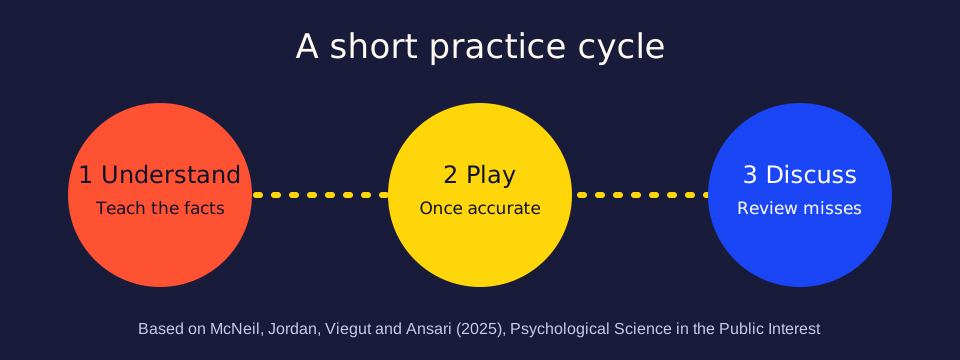
A 2025 review in Psychological Science in the Public Interest, by Nicole McNeil, Nancy Jordan, Alexandria Viegut and Daniel Ansari, describes arithmetic fluency as more than fast recall. It includes noticing how numbers relate. The authors recommend a cycle: build understanding of the facts, use brief timed practice to make them automatic, then return to discussion. Their most useful warning for anyone running this game is about timing. Time limits should come after learners can answer accurately. Before that point, a clock only rewards guessing or fast counting.
The case for short, timed practice
In a study led by Lynn Fuchs at Vanderbilt University, published in 2013 and reported by The Hechinger Report, struggling first graders received tutoring three times a week for 16 weeks. One group reinforced lessons with untimed games. The other tried to answer as many flashcards correctly as possible in 60 seconds, aiming to meet or beat their earlier score. The speed practice group reached much higher maths achievement and answered more facts correctly each day.
A What Works Clearinghouse panel also rated the evidence for timed activities as strong, drawing on 27 studies, in its 2021 practice guide for elementary students who struggle with maths. Two limits matter. The studies suggest timed activities help mainly as part of a larger intervention, and Fuchs's study is one of few directly comparing timed and untimed practice. Notice too that those children tried to beat their own score. A tug of war game puts players against each other, which is a different situation.
Competition versus cooperation
An older synthesis of 122 studies by David Johnson and colleagues found cooperation produced better achievement than competition between individuals. A 2025 meta-analysis of 30 recent studies of primary pupils reported a moderate to large benefit for cooperative learning in mathematics (Hedges' g of 0.71), and pointed to structured approaches such as Jigsaw and STAD. Teams-Games-Tournament and STAD mix cooperation inside a team with competition between teams, and studies of them give mixed results. That is the closest research family to a classroom tug of war, and it suggests team structure matters more than the game's excitement.
Does a timed game cause anxiety?
Researchers disagree, and the question is not settled. In a study in the Journal of School Psychology, Kathrin Maki and colleagues gave 113 fourth and fifth graders timed tasks and found no significant difference in reported anxiety between being openly timed and being stopped without warning. Harder problems did produce more anxiety and fewer correct answers. The National Council of Teachers of Mathematics takes the opposite practical position, saying timed tests should be avoided. Our guide to timed games and anxiety covers how to lower the pressure.
What this means for a tug of war match
Use it for facts players already know.
Discuss strategy before and after a match.
Keep it short and use teams or pairs, so losing is shared.
Set levels so each team can answer accurately.
Spend more time on the missed questions than on who won.
Avoid it for brand new topics, or when a player finds public speed distressing.
What we do not know
We found no controlled study of online maths tug of war games. Claims that such a game makes children learn several times faster have no published evidence behind them that we could find. Treat any such figure with suspicion, including on game sites.
Sources
McNeil, Jordan, Viegut and Ansari (2025), What the Science of Learning Teaches Us About Arithmetic Fluency, Psychological Science in the Public Interest 26(1). The Hechinger Report, Proof Points: Do math drills help children learn? Education Week, Do Timed Tasks Really Worsen Math Anxiety? (August 2024), on Maki, Zaslofsky, Codding and Woods in the Journal of School Psychology. What Works Clearinghouse (2021), Assisting Students Struggling with Mathematics. Johnson and colleagues, synthesis of 122 studies on goal structures and achievement.
Frequently asked questions
Has anyone studied online maths tug of war games directly?
We could not find a controlled study of online maths tug of war games. The advice on this page applies research on timed practice, competition and cooperation.
When should timed practice start?
The 2025 review by McNeil and colleagues recommends time limits only after answers are accurate.
Is team competition better than one-on-one competition?
The evidence is mixed. Studies of team formats such as Teams-Games-Tournament give varied results, which suggests the way teams are organised matters.