Timed Maths Games and Anxiety: How to Keep Practice Safe
Do timed math games cause anxiety? Nobody has proved that they do, and nobody has proved they are harmless. The person in front of you is better evidence than either claim. If speed upsets a player, change the activity using this table.
If a player | Try this |
|---|---|
Guesses to end the round | Lower their level until they can answer accurately |
Freezes in front of others | Let pairs answer together, or practise privately against the Gentle robot |
Avoids their turn | Give them another role, such as score keeper or question reader |
Gets upset by losing | Play in teams, and compare with their last game instead of with others |
Dislikes the clock itself | Use the dice version, which has no timer |
What have researchers found?
A study of 113 fourth and fifth graders in the Journal of School Psychology compared being openly timed with being stopped without warning. Reported anxiety did not differ significantly. Harder questions raised anxiety and lowered accuracy. That result hints that difficulty may matter as much as the clock, but the study was small and relied on children describing their own feelings.
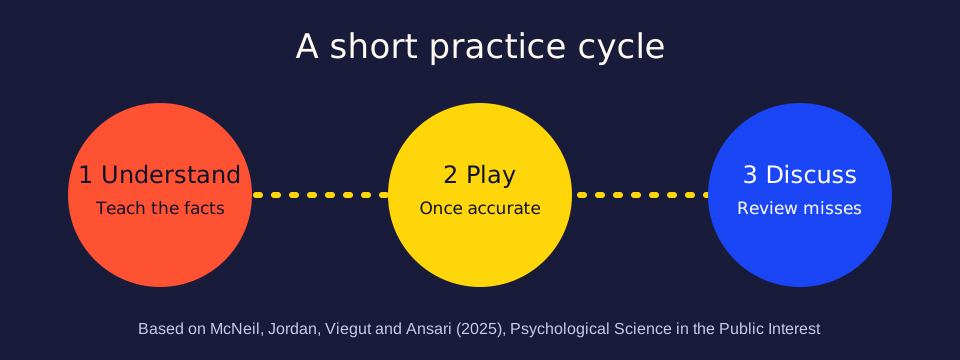
The National Council of Teachers of Mathematics advises avoiding timed tests. The Hechinger Report notes that no well-designed experiment has shown timed tests cause anxiety. Both positions can guide a teacher: there is no firm evidence of harm, and there is good reason to take care. A 2025 review led by Nicole McNeil recommends brief timed practice only after learners answer facts accurately. Following that one rule removes much of the pressure.
Lowest-pressure settings in the game
Choose a level where most answers are easy, since difficulty is the factor the Maki study connected with anxiety.
Pick the longest match, 3 minutes.
Play alone against the Gentle robot, which takes about 5 seconds per answer.
Give each team its own level with our mixed-ability setup.
Signs a player is finding it too much
Look for someone who avoids their turn, guesses quickly to end the round, freezes in front of others, says they are bad at maths after a game, or becomes upset over losing. These signs matter more than a good average across the group.
Words that help
Try "Which fact was tricky? What could help next time?" and "You got faster at the 6s." Education Week reports researchers noting that comparing children's times can embarrass them, while beating your own time can motivate. Avoid naming fastest and slowest players, and avoid using a match as a reward or a punishment.
When to skip the game
Skip it during a new topic, on a day when someone is already struggling, or for anyone who has asked not to perform in front of others. If maths worry is affecting a child's school life, talk to their teacher or a specialist. A game cannot address that alone.
Sources
Maki, Zaslofsky, Codding and Woods, Journal of School Psychology, as reported in Education Week (August 2024). The Hechinger Report, Proof Points: Do math drills help children learn? McNeil and colleagues (2025), Psychological Science in the Public Interest. National Council of Teachers of Mathematics position on procedural fluency.
Frequently asked questions
Do timed maths games cause anxiety?
That is unresolved. No well-designed experiment has shown that timed tests cause anxiety, but a particular player may still find speed stressful.
Can you play maths tug of war without a clock?
Yes. The dice version has no timer, and it needs only paper, two dice and a counter.
What is the gentlest way to play on screen?
Choose a small number range, the longest match of 3 minutes and the Gentle robot.