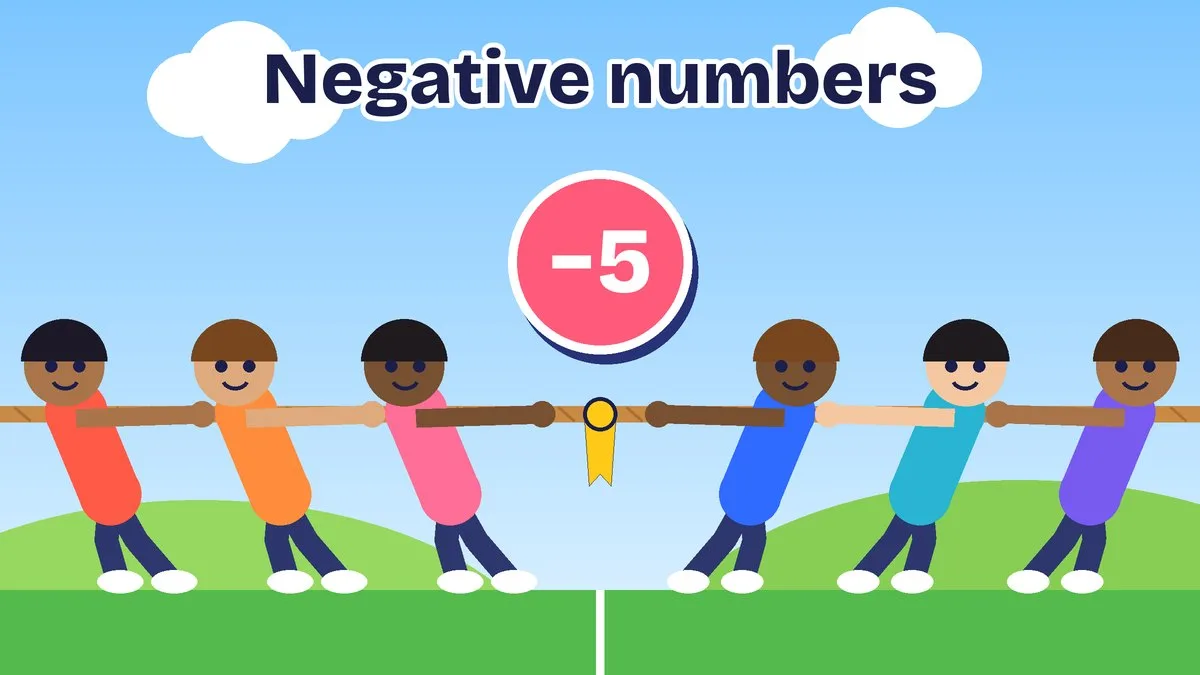
Negative numbers tug of war at the top of this page practises adding, subtracting and, at higher levels, multiplying integers. The rope is a number line with zero at the flag. Pick your level and use the sign rules below.
Question | Rule | Example |
|---|---|---|
Adding a negative | Move left | 3 + (−5) = −2 |
Subtracting a negative | Move right, as if adding | 4 − (−2) = 6 |
Same signs multiplied | Answer is positive | −5 × (−3) = 15 |
Different signs multiplied | Answer is negative | −2 × 6 = −12 |
Which level should you choose?
Numbers run from minus the level to plus the level, so Easy uses −10 to 10 and Master uses −100 to 100. From Hard (up to 20) upward, about 4 in 10 questions are multiplication, using numbers from −12 to 12. Start on Starter or Easy, because the signs are the hard part and small numbers let players focus on them.
How does the rope model integers?
Treat each pull left as −1 and each pull right as +1. If the rope is at +3 and the left team pulls five times, three pulls bring it to zero and two more take it to −2, so 3 + (−5) = −2. Players can see why the answer changes sign. To try it without a screen, draw a line from −10 to 10, place a counter at zero, and let partners pick cards, moving right for a positive and left for a negative.
What mistakes are most common?
Learners often add the digits and keep the first sign, so −3 + 5 becomes −8. Others think subtracting always makes a number smaller, which fails for 4 − (−2). The game plays on this: one wrong button is often the answer you would get by mixing up adding and subtracting. If you see 2 offered for 4 − (−2), that is the trap. Ask which way the rope moves and how far.
Writing your own set
To target particular facts, write one question per line on the custom questions page. For example: −3 + 5 = 2, 4 + −9 = −5, −6 + −2 = −8, 7 − 10 = −3, −4 − 3 = −7 and −18 ÷ 3 = −6. The game makes nearby wrong answers, including negative ones.
When to use it
Teach the idea with a number line first, then use a match to practise. Standard expectations place this in grades 6 and 7 in the United States and upper primary to early secondary in England. It also fits the mix in our middle school guide.
What numbers does each level use?
| Level | Range | Includes multiplying? |
|---|---|---|
| Starter | −5 to 5 | No |
| Easy | −10 to 10 | No |
| Medium | −12 to 12 | No |
| Hard | −20 to 20 | Yes |
| Expert | −50 to 50 | Yes |
| Master | −100 to 100 | Yes |
Four questions, worked on the rope
−3 + 8: start 3 left of the flag, move 8 right, end at 5. 2 − 7: start 2 right, move 7 left, end at −5. −4 + (−6): start 4 left, adding a negative moves further left, end at −10. −1 − (−9): start 1 left, subtracting a negative moves right, end at 8.
A way to explain minus a negative
Think of the rope as a score. Losing a penalty is a gain: if someone takes away a debt of 2, you are 2 better off. So 4 − (−2) is 6. Ask players to say the sentence in words before answering until it becomes automatic.
Frequently asked questions
Why does a rope help with negative numbers?
The rope works like a number line, with the flag at zero and each side as one direction.
Does the negative numbers game include multiplying?
Yes, sometimes. Multiplying negative numbers appears from the Hard level upward.
How is minus a negative shown?
The second number is shown in brackets, such as 4 − (−2).