For Multiplication Tables Check practice, use this four-week routine of short tug of war matches alongside typed or written recall. The check is taken by Year 4 pupils in England: 25 questions, six seconds each, tables up to 12 × 12, and no pass mark.
Week | Tick in the game | Strategy to name |
|---|---|---|
1 | 3 and 6 | Double the 3s to reach the 6s |
2 | 7 | 5s plus 2s |
3 | 8 and 9 | Double three times; 10s minus one lot |
4 | 6, 7, 8, 9 and 12 | 12s are 10s plus 2s |
What to do in each lesson
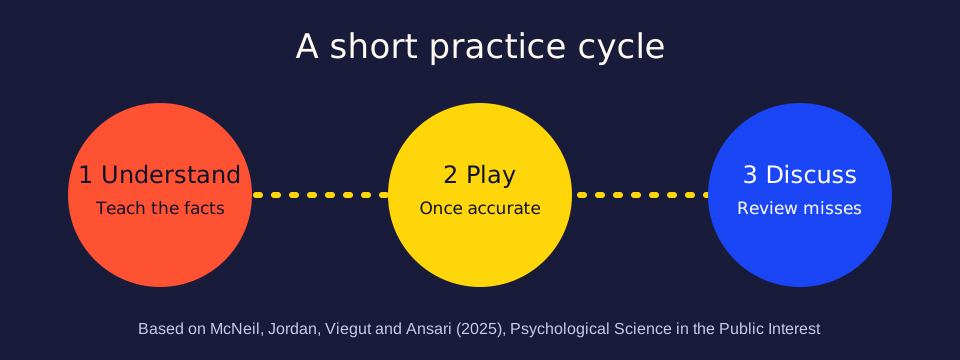
One minute: name the target table and its strategy.
90 seconds: play one match with only those tables ticked, at Medium (up to 12).
Two minutes: read the review list and ask how to work out the hardest fact.
Finish with five answers typed or written from memory.
What does the check ask for?
Each pupil works alone on a device. Questions appear one at a time, answers are typed, and the check is weighted toward harder tables such as the 6s, 7s, 8s, 9s and 12s. The national curriculum expects pupils to recall multiplication and division facts up to 12 × 12 by the end of Year 4. For current dates and rules, follow the Standards and Testing Agency's guidance.
Where does tug of war fit?
The game gives pupils repeated, quick retrieval, and a 2025 research review led by Nicole McNeil supports brief timed retrieval once learners are accurate. It differs from the check in useful ways. Pupils pick from four answers, so they are recognising the product rather than producing it. That makes the game easier than typing the answer, so treat it as a confidence builder and warm-up. It is not the official check.
Six seconds is longer than it sounds
A pupil who can answer within about 3 seconds in the game has a comfortable margin, while one taking 5 or more has little room for typing. Use the robot as a quiet benchmark: beating the Gentle robot takes about 5 seconds per answer, and beating Steady takes about 3.5, according to our simulation of the game's rules. Those figures are a model, not a measure of any pupil.
Choosing teams
Mix attainment within teams and rotate who comes to the board. Set a lower level for a team that needs it. Pupils who find speed stressful can answer as a pair, or practise privately on a tablet.
Mistakes to avoid
Do not start timing a table pupils cannot yet answer accurately. Do not use class rankings, and do not tell pupils the check is high stakes. It exists to inform schools, and the game should keep that calm tone. More practice ideas are on the times tables page.
Sources
Standards and Testing Agency guidance on the Multiplication Tables Check. Department for Education, National curriculum in England: mathematics programmes of study. McNeil and colleagues (2025), Psychological Science in the Public Interest.
How long is the check?
With 25 questions at six seconds each, the answering time is 150 seconds at most, or two and a half minutes. Short practice routines match that well. Pupils do not need long sessions. They need frequent, accurate recall of the facts that are still slow.
A simple way to track progress
| Stage | What you see | What to do |
|---|---|---|
| Not yet | Slow and often wrong | Teach a strategy with no clock |
| Accurate but slow | Right, after working it out | Brief timed practice on this table |
| Secure | Quick and right | Mix in with other tables |
Sort each pupil's tables into these three stages once a fortnight, using written or typed answers rather than the game alone.
Frequently asked questions
Is this game the official Multiplication Tables Check?
No. It is a separate practice game and does not copy the check's format.
How many questions are in the Multiplication Tables Check?
Pupils answer 25 questions, with six seconds for each one.
Why add written practice after the game?
The game offers four answers to choose from, while the check asks pupils to type the answer.