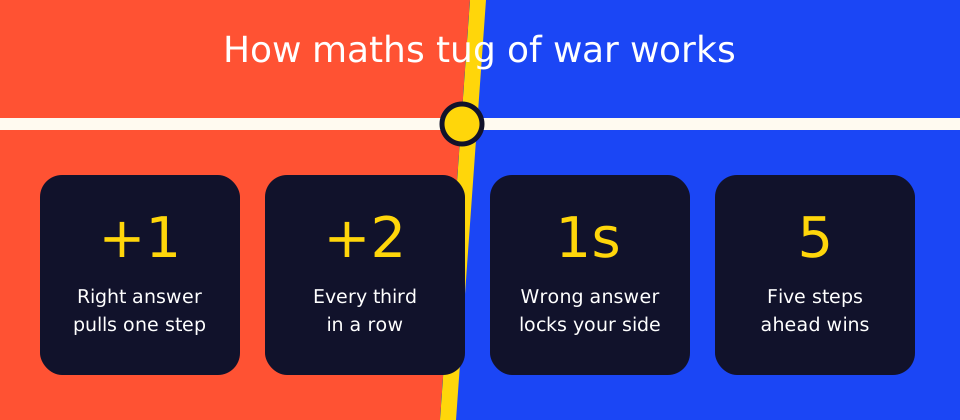
Subtraction tug of war is a free two-team game: answer subtraction questions to pull the rope toward your team. The larger number always comes first, so answers never go below zero. Pick the level below that suits the players.
Level | Example | Suits |
|---|---|---|
Starter (up to 5) | 5 − 2 | First subtraction facts |
Easy (up to 10) | 9 − 4 | Number bonds to 10 |
Hard (up to 20) | 17 − 9 | Facts within 20, bridging through 10 |
Expert (up to 50) | 42 − 17 | Two-digit mental subtraction |
Master (up to 100) | 91 − 38 | A strong mental workout |
Facts within 20 are what pupils are expected to know fluently by the end of Year 2 in England and grade 2 in the United States. Above that, players are calculating more than recalling, so give them a longer match. An answer of 0 is possible. To work below zero, choose the negative numbers topic instead.
Which strategy fits which question?
When you see | Try | Example |
|---|---|---|
A small number to take away | Count back | 9 − 2: 8, 7 |
Two numbers close together | Count up the gap | 12 − 9: from 9, count 3 on |
A fact you know as addition | Use the fact family | 8 + 5 = 13, so 13 − 5 = 8 |
A crossing of 10 | Bridge through 10 | 14 − 6: take 4 to 10, then 2 more |
A number close to a ten | Round and correct | 53 − 19 is 53 − 20 + 1 = 34 |
What mistakes are most common?
Learners often subtract the smaller digit from the larger whatever the order, so 42 − 17 becomes 35 instead of 25. Others count back and include the starting number, which makes answers one too small. When the same error appears on the review list, ask the player to show their method on a number line.
Using it with a class
Teach the strategy first. Play a 90-second match on facts the class has practised, then discuss the two facts most often missed. A 2025 research review led by Nicole McNeil recommends this cycle of understanding, brief timed practice and discussion. Alternate with addition matches so players notice the same facts running both ways, and see the grades 2 and 3 guide for lesson ideas.
A round of subtraction, played through
Blue is on Hard and sees 17 − 9. The numbers are close together, so counting up works best: 9 to 10 is 1, and 10 to 17 is 7, making 8. Next comes 18 − 5, a small take-away, so Blue counts back to 13. Then 16 − 8, which Blue knows as half of 16. Three different questions, three different methods, and three correct answers in a row earn a power pull.
Why is subtraction often harder than addition?
Addition can be done in either order, so 3 + 9 and 9 + 3 are the same fact. Subtraction has an order that matters, and counting back is more error-prone than counting on. That is why linking each subtraction to an addition fact you already know pays off so well. If 7 + 8 = 15 is secure, both 15 − 7 and 15 − 8 come for free.
A plan for facts within 20
| Stage | Practise | Setting |
|---|---|---|
| First | Subtracting from 10 | Number bonds, Easy |
| Next | Taking away small numbers | Subtraction, Easy |
| Then | Bridging through 10 | Subtraction, Hard, 2 minutes |
| Finally | Mixed with addition | Alternate addition and subtraction matches |
Frequently asked questions
Can subtraction answers be negative?
No. The larger number always comes first, so answers never go below zero.
Which level should I choose?
Easy (up to 10) suits number bonds, and Hard (up to 20) covers facts within 20.
Can I practise negative numbers instead?
Yes. Choose the Negative numbers topic in the settings.