What Is Tug of War Mathematics?
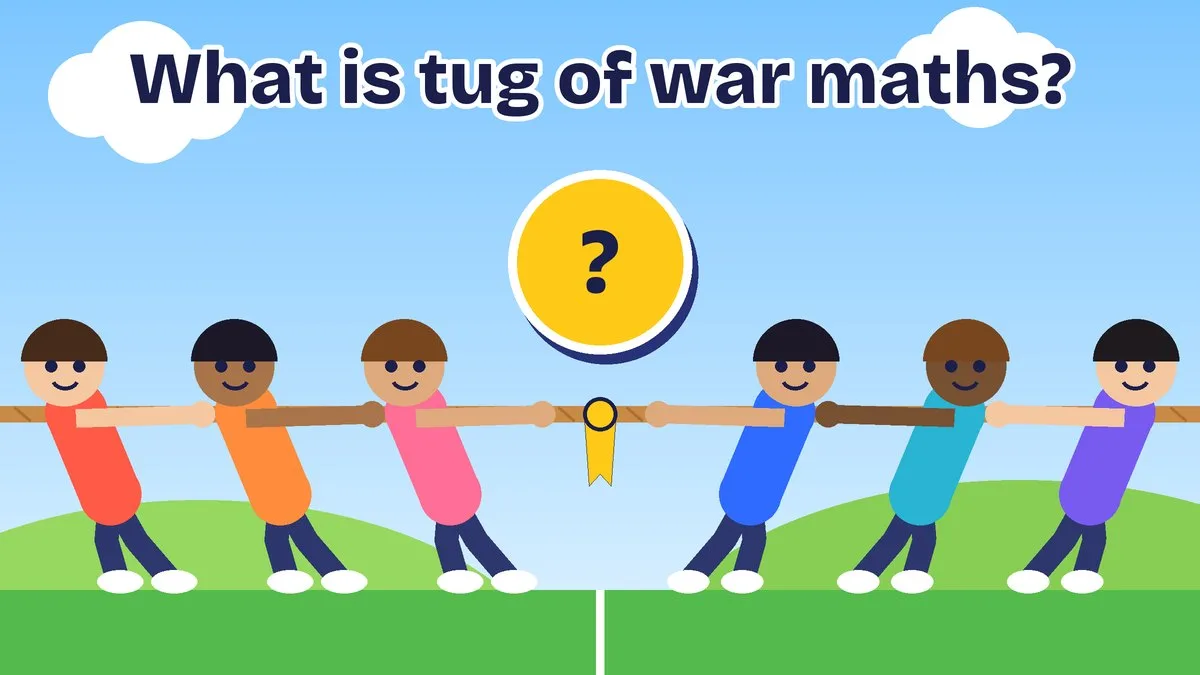
Tug of war mathematics is a game in which two players or teams answer maths questions, and each correct answer pulls a rope toward their side. Maths tug of war, math tug of war and tug of war maths all describe the same idea.
Both sides get questions at the same moment.
Each correct answer moves the rope toward the side that gave it.
A side wins by pulling far enough, or by being ahead when time runs out.
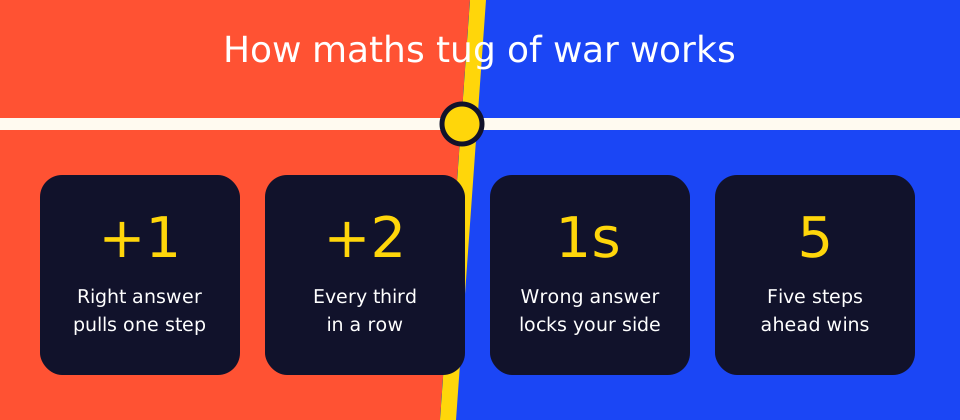
Play a free match now, or read the full rules. On this site a five-step lead wins, every third correct answer in a row pulls two steps, and a wrong answer locks that side for one second.
The main ways it is played
Format | You need | Works best when |
|---|---|---|
A phone, tablet or computer | Two people or teams are together | |
A touchscreen that accepts two touches | A class watches and swaps players | |
One device per player | Everyone should answer at once | |
A drawn track, two dice, a counter | There is no screen, or no clock is wanted |
What maths can it cover?
The format suits any question with one clear answer. Most games stick to addition, subtraction, multiplication and division. Ours also covers number bonds, doubles and halves, missing numbers, fractions, decimals, percentages, negative numbers, order of operations, simple algebra, and squares and square roots. A question like 3x + 4 = 19 works just as well as 3 + 4, so the same game can suit a beginner and an adult. You can also write your own questions.
How is it different from physical tug of war?
In the sport, strength, grip and footing decide the winner, as our guide to the forces explains. In the maths version only correct answers move the rope. The picture still does useful work: the middle flag acts like zero on a number line, which is why the game can help explain negative numbers.
Why does a simple rope make practice engaging?
A worksheet tells you how you did at the end. The rope tells you after every answer, and the other side's progress is right there. Lead changes create tension without any explanation, and the rules take seconds to learn.
Who does it suit?
The game suits facts players have already learned and want to recall quickly, such as number bonds and times tables. It works at any age, as long as the questions match what the players know. On one screen, each team can have its own level, so people of different ages or confidence can play a close match.
Where it falls short
It does not teach a new idea. Someone who does not understand multiplication will not learn it by being timed, and speed can make some players anxious. On a shared board, only the players at the screen are answering. We found no controlled study of online maths tug of war games themselves. Research on nearby practices is summarised in does competitive maths help learning and timed games and anxiety.
Where did the online game come from?
Physical tug of war is very old, and teachers have used number-line versions with dice for years. Keyword data we reviewed in November 2026 shows search interest in the maths version rising sharply from late 2025, first in Indonesia and Uzbekistan, then in English-speaking countries in early 2026. We could not confirm what set it off.
Frequently asked questions
Is tug of war mathematics only for children?
No. The format suits any age, because the questions can range from small sums to algebra and percentages.
Do you need a rope to play tug of war mathematics?
No. The online game uses an animated rope, and a paper version needs only a drawn line, two dice and a counter.
Is maths tug of war free to play?
Yes. The game on this site is free to play, with no account or download.